


My May was filled to the brim, 3 jobs coalescing at once, highlighted by re-opening the summertime cafe I cook at here in Oregon’s wine country. Between that, and some time spent in Minnesota, I was doing a lot of menu planning, looking back at my first food ventures and thinking about what my own culinary voice is. This month’s (while, last month’s, as I’m one day late) is a brief personal essay about my own family’s culinary traditions, hopefully something of a lighter read in between the deep dives on global producers/chefs I normally feature.
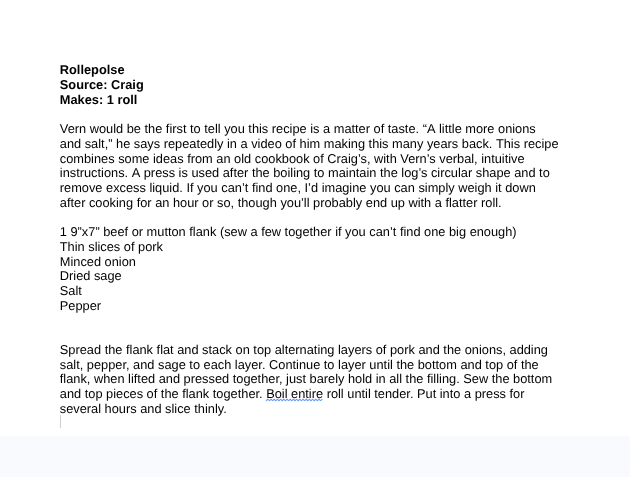
An old family video shows my great-grandfather Vern layering sage, onions, salt, and slices of thin pork on top of a butterflied beef flank. “A bit more onion!,” Vern insists in a thick Minnesotan accent, just when you think the filling must be at capacity. “A touch more salt!” It goes on and on, the pile growing, until finally he rolls it up and ties it. He stands there, in front of the Rollepulse he’s crafting, by no means boastful but with a tone and demeanor that those of us of Scandinavian descent know to read as pride.
We watched this, as an extended family, years back. My uncle had wanted to try to recreate this old Norwegian family staple that had been absent from family gatherings at least since I was born. I am the youngest of all my Johnson cousins, ten years younger than my oldest brother. My memories of family food traditions span the shortest length of time, which may have something to do with the fact that amongst my cousins I seem most keen on researching and preserving them. I remember pickled herring most always, lutefisk on rare occasions for the adventurous, Swedish meatballs without fail–but things like the Rollepolse, a log of meat filled with seasoning before being boiled, pressed, chilled, and sliced–those things went missing likely long before I was born.
Rollepolse is not the kind of thing you will find articles on Bon Appetit on. You will not be able to ask your relatives what it should taste like, or how gelatanized the meat should be. A Google search turns up a small amount of recipes, and even fewer pictures. This roll of cold meat, generally served on open-faced bread, will never trend.
The version that was the centerpiece of our Christmas table that year was…fine. Not bad. Heavy with onions, salt, and sage, it was hard for it not to be flavorful; but that doesn’t mean it was divine. Which was not my uncle’s fault: all he had to go on was Vern’s intuitive touch and feel, an old video with no measurements.
A little more sage, a little more salt: Vern’s invitation to learn that intuitive touch for ourselves.
This, the fourth season of NCR Cafe, and my second year running the kitchen, got off to a hectic start. The whole space was renovated, which didn’t fnish up around 10pm the night before we opened on Friday. I was in Minnesota until a few days beforehand, and couldn’t get into the kitchen to clean and set up until Wednesday. Thursday I prepped food late into the evening, then woke up early Friday to finish. At noon we opened our doors to the public. None of the dishes, outside of a salad we always keep on the menu, were things I had tested before.
A 60 hour work week later, I would look back and think things went pretty well on the whole. The food was more or less tasty, albeit in need of a few tweaks; I hadn’t forgotten to order anything imperative; the new space was cozy and comfortable for guests. But I looked over the menu and wondered where my own voice was: the potato pave was something I had seen on social media recently, the lovage sauce was sourced from a favorite chef of mine back in Minnesota, the sausage dish was a traditional Alsatian favorite, and the chocolate dessert was recently on a menu at a restaurant in London I often draw inspiration from. I didn’t feel like I was plagurizing–many of these things are traditional dishes that have been cooked forever–it’s just that I wondered where my own stamp was.
Last summer was my first chance to finally cook my own food in years. I had traveled the world, accumulated techniques and ideas, and finally had an outlet. I took full advantage of that, playing around with global flavors, testing out new dishes and iterations of those dishes constantly, spurred on by a creative energy that I’d been missing in my life since I ran a bakery and baking school in North Carolina.
The joy and humility–the letting go, I should say–of year two is that I don’t feel this pressing need to try everything under the sun. I read last year’s menu now as not just creative exploration but an ardent need to prove myself. The menu this summer is decidedly more classically French, as we are a french bistro of sorts, serving french style wine. I’ve been reading old French cookbooks, sourcing recipes and inspiration, filling in the gaps of my culinary education because I sidestepped French cooking altogether by never going to culinary school.
But where is the line between honoring tradition and regurgitating past ideas? Where does one find their own voice amidst it all?
I devoured cookbooks from an early age. I looked up to my favorite chefs, bought all of their cookbooks, absorbed as much as possible. And many of these luminarees all talked about one chef in particular as their own inspiration: Michel Bras.
I found a copy of the first edition of his cookbook (a difficult thing to find in those days; since then it’s been republished). I looked at every recipe, every component. Bras was one of the first all time greats of modern cooking, at least in the West, bringing life back into the cuisine of the french countryside in an era where the best restaurants were thought to be found in the city, bringing lightness and freshness to the forefront in an era of heavy, rich food. When you look at his plating and recipes, vibrant vegetables and sauces bring motion onto the plate like a painting, dishes feel ardously composed and, yet, whimsical all at once. They read in other words as distinctly him, distinctly Bras–and yet it also seems to be eschewing ego and rather highlighting the ingredients themselves. He had turned an eye to the food of his region and given it new possibilities.
Michele Bras inspired many to look back at their own roots. Chef’s Table, the Netflix series, highlighted chefs around the world doing just that, and seemingly since then food media in the last decade has hyper-focused on this, both giving underappreciated chefs a platform while at times uplifting the rotten ones.
I am not always sure where to turn for my own inspiration. I was raised in the Midwestern suburbs, at the end of a cul-de-sac, in a culture that prioritized strip malls and sameness. The first dinner I cooked for my family—a chore of mine growing up—was hard shell tacos from the box, an education in the power and persuasion of cumin.
I’ve tried to dig deeper, collecting old family recipes from my grandparents and beyond, and nearly all of them are from what I call in my head the Shortcut Era. Canned goods, microwaves, quickbreads–all new and novel things back then that greatly reduced the effort needed to cook, a welcome thing for many families who had forever had to do things the hard way. The family rice pudding recipe I have, for example, is based a Swedish masterpiece, but the initial instructions go like this:
Cook rice according to package. Put 3 C. milk in microwave safe bowl. Heat 3 minutes on medium. Add the rice, cornstarch, salt, ½ cup of the sugar, and the remaining cup of milk and heat 2 minutes.
The Rollepolse recipe I have, too, strikes me as full of shortcuts. Look up versions online and you’ll see the real deal is supposed to be brined for days and days before finally being boiled, to tenderize the meat, to let all the flavors meld together. That’s not a part of Vern’s recipe, or at least I didn’t grasp that from the video. Would that have made it more delicious? Yet there’s also the question of whether things like Rollepolse were designed to be delicious or more to preserve meat for the long cold winters. At least to most modern palates, a cold slab of gelatanized meat might not be worth all the effort.
Where does one turn back to, in the search for traditions that have been largely severed? I try to remind myself that whatever inauthenticity I prescribe to these shortcut recipes is hyperbolic, that they are very real and interesting in their own right and still give clues as to what came before them. And even moreso, I try to remind myself that there are countless chefs and cooks from immigrant communities that have an even harder job of picking up the pieces from a fragmented diaspora and piecing them together on the plate. And, of course, that not everyone has to choose to do so.
Yet still, trying to piece together a fabric of family history and cultural traditions can feel like grasping in the dark.
I’m making Rollepolse this week. Well, stuffing and brining a pork tenderloin, anyway, to be cooked in the coming days. If it’s good, it will make the menu–though I can’t say I know exactly what a “good” Rollepolse should be like. Maybe a bit less onions will go in this version, Vern be damned. Maybe I’ll mix in some other herbs with the sage, put juniper in the cooking liquid. I’d rather roast it then boil it, but then could I still call it Rollepolse? I think it might work well, served as the Italians serve thin slices of veal, with a tonnato sauce on top and some fresh lettuces or shaved fennel.
And maybe it won’t work. Maybe it will be a fruitless exercise in trying to add my own voice to a menu steeped in traditions that go back far beyond me, a reminder to myself that not everything I cook needs to be imbued with meaning. But at least I’ll have tried, stitching together, as Vern did, some large and layered thing, tying it up and hoping it stays together in one coherent mass, if for no one else than at least for myself.
I appreciate the term "shortcut era," - which is what my mom of 8 specialized in. I've sometimes called it the era when convenience was trendy and newfangled. Love the way you balance your roots and your adventuresome spirit.